Viridis A
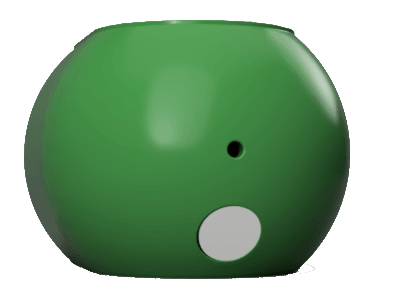
Quieter running and longer endurance. For longer missions and greater depth.
- Max depth
- 10 m
- Propulsion
- Flywheel V2
- Length
- ~250 mm
- Purpose
- Longer missions
Build your own submarine.
01why Viridis
A submarine anyone with a printer and some patience can build.
Models, schematics and firmware are free to download. No sign-up, no licence fee.
Hull and internals come off an ordinary printer. PETG, 20 % infill.
Thrusters built into the hull instead of external propellers. Nothing sticks out.
Watertightness verified in a pressure chamber, movement in the TechTower tank.
Parts cost a fraction of a finished ROV. Nothing special to source.
Documentation at three levels of detail — from principle to build.
02variants
The hull and electronics are shared. The propulsion differs — and with it what each variant is good for.
Quieter running and longer endurance. For longer missions and greater depth.
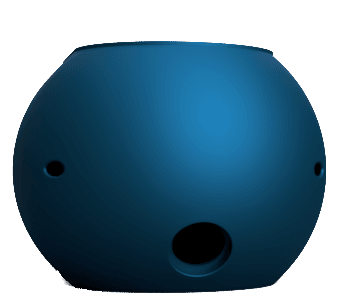
Faster response and better manoeuvring on the spot.
03how it works
The four principles the whole movement rests on. No external propeller.
The ballast tank fills with water. Density rises and the submarine starts to sink to target depth.
Thrusters push water backwards. The reaction moves the submarine forward — with no external propeller.
The left and right thruster push with different force, smoothly turning the hull.
The high-pressure pump empties the tank. The submarine gets lighter and rises to the surface.
04specifications
Parameters of both variants. Highlighted values differ between them.
| Parameter | Viridis A | Viridis B |
|---|---|---|
| Length | ~250 mm | ~250 mm |
| Weight· | ~5 kg | ~4 kg |
| Material | PETG | PETG |
| Print time· | ~20 h | ~22 h |
| Max depth | 10 m | 10 m |
| Propulsion· | Flywheel V2 | ROV 4× thrusters |
| Thruster flow· | 240 l/h | 120 l/h |
| Battery | PB 12 V 0,8 Ah GETI | PB 12 V 0,8 Ah GETI |
| Electronics | Arduino Nano | Arduino Nano |
| Camera | Yes | Yes |
05project timeline
From the first sketches to a submarine that dives and surfaces.
06in action
Footage from testing in the water tank.
First dive
Loading will connect you to youtube.com.
07comparison
Compared with a commercially sold ROV of a similar size.
| Parameter | Typical ROV | Viridis |
|---|---|---|
| Price | $400 – $4,000 | ~$200 |
| Licence | Proprietary | Open source |
| Manufacturing | Factory | 3D printing |
| Parts | Special, expensive | Off the shelf |
| Propulsion | External propellers | Built-in thrusters |
| Built by | Companies | Students |
| Source code | Unavailable | On GitHub |
| Documentation | Limited | Complete and open |
08gallery
Cross-sections and details showing how the submarine fits together.
Competitions
Photos after the first race
09open source
Models, schematics and firmware are freely available. This is the whole process.
10news
Build progress, tests and competitions.
11support
Without these organisations Viridis would have stayed on paper.